
Mohamed and Stanic Lab team publish study in American Journal of Reproductive Immunology
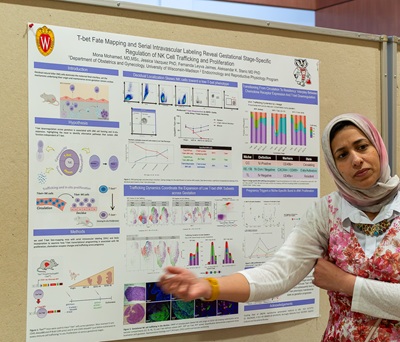
Mona Mohamed, PhD candidate in the Stanic Lab, is first author on a new article published in the American Journal of Reproductive Immunology. Co-authors include Yan Li, Andrea Wegrzynowicz, PhD, Payton Lindner, Jessica Vazquez, PhD, Gladys Lopez, and Aleks Stanic, MD, PhD.
In the study T-bet Fate Mapping Reveals Gestational Stage-Specific Transcriptional Adaptation of Decidual NK Cells, Mohamed and co-authors used a sophisticated genetic fate-mapping mouse model to track decidual natural killer (dNK) cells (immune cells that support placental development and immune balance in the pregnant uterus) to reveal their programming and distribution in decidua/placenta. Flow cytometry, RNA sequencing, and single-cell transcriptomics were used to follow dNK cells that expressed T-bet, a transcription factor that drives cytotoxic and inflammatory programs, across successive stages of pregnancy.
dNK cells were found to progressively silence T-bet in a tissue and gestational age-specific pattern yet retain their core dNK identity rather than converting to a different cell lineage. dNKs shut down their cytotoxic gene-expression programs and acquire tissue-residency and regulatory role by late gestation. The results reveal that dNK cell plasticity at the maternal-fetal interface arises through transcriptional reprogramming and subset rebalancing rather than lineage diversion: a distinction that bears on understanding both healthy pregnancy and complications associated with immune dysregulation.
Read the whole publication here.