
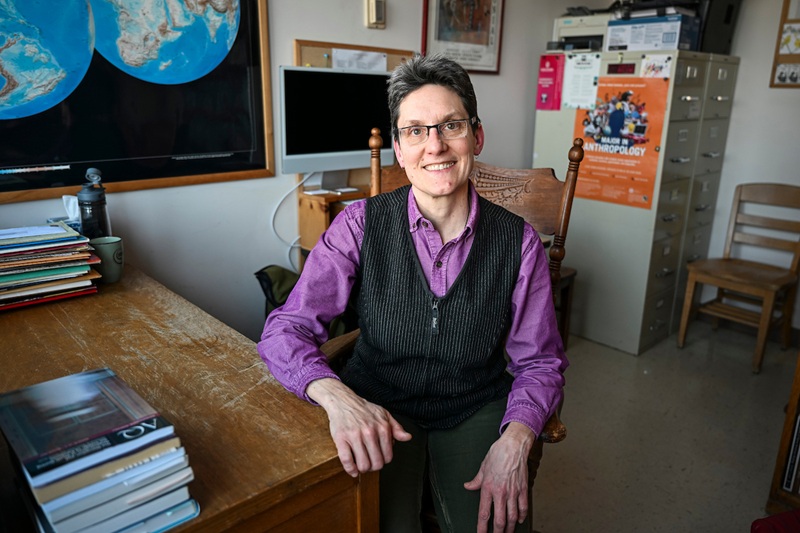
Claire Wendland selected for Guggenheim Fellowship
Claire Wendland, MD, PhD, professor in the University of Wisconsin–Madison Department of Anthropology and the UW School of Medicine and Public Health Department of Obstetrics and Gynecology, was selected as a Class of 2026 Guggenheim Fellow, as awarded by the Board of Trustees of the John Simon Guggenheim Memorial Foundation. She receives the award for her work in African Studies.
Dr. Wendland, who is a trained obstetrician-gynecologist as well as a medical anthropologist, has been an impactful researcher, teacher, and mentor with a career focused on the complex relationships involved in practicing medicine on people around the world.
The Guggenheim Fellowship provides a monetary stipend to each recipient to support their independent work under “the freest possible conditions.” Dr. Wendland’s award will support the research and drafting of a manuscript built around the remarkable story of Dr. Daniel Malekebu, Malawi’s first doctor — but that also illustrates ties between Central Africa and the Jim Crow South in the U.S. in the early twentieth century.
Dr. Wendland has received multiple faculty awards from the University of Wisconsin–Madison in recent years, including: the Vilas Distinguished Achievement Professorship in 2025; the 2024-25 Hilldale Award in the Social Sciences; and the 2017 Chancellor’s Distinguished Teaching Award. The Guggenheim Fellowship is an exciting, international honor in an already-celebrated career.
In recognition of her Guggenheim Fellowship, Dr. Wendland shared reflections on a path that began in medicine and wound its way to anthropology; why teaching and mentoring are important cornerstones of her career; the lessons anthropology can share with clinical medicine; and what the Guggenheim Fellowship will mean for her work.
This conversation has been edited for length and clarity.
Which came first, medicine or anthropology?
I was in ob-gyn practice for years before I went back to graduate school and did a PhD in Anthropology. After medical school and residency, I went to work on the Navajo Reservations, including five years in Gallup, New Mexico and six years in Chinle, Arizona. I found myself thinking a lot about culture and health and how they work together. And I realized that the scholarship in medicine at that point was not strong on this.
I found myself thinking back to the one anthropology class I took in my undergraduate degree and thinking, I'd like to do some work in this area. I returned to school for a PhD and then joined the University of Wisconsin faculty in anthropology in 2005. After a couple years of balancing both clinical medicine and anthropology, I decided in 2007 to focus on anthropology.
What value does teaching and mentoring bring to your career?
I enjoy teaching. It's an interesting place to learn, it's fun to be in a room of people who are all learning together. Teaching keeps you on your toes, you never know exactly what's going to happen.
In the Department of Anthropology, I teach big undergraduate courses. I get to teach the occasional graduate seminar. I particularly like to teach Medical Anthropology, so courses on medicine, health, and illness. Some of them focus specifically on the United States and on health and equity and disparities in the United States. Others are more internationally focused.
In the Department of Obstetrics and Gynecology, I mainly work with the Division of Reproductive and Population Health, mentoring postdoctoral scholars.
What has your research focused on?
Much of my work has been field research in Malawi, sometimes in visits as short as a month or as long as a year. Some of my work has been collaborative, and some has been solo projects. I did a big study of Malawi's first medical school, which became my first book A Heart for the Work: Journeys through an African Medical School. And then I did another study of how people talk about and explain maternal death in Malawi and how those different kinds of stories about maternal death all work together to support certain kinds of policies, or to downplay others, give us some insight into the country's history or project into the future, all of these things.
What can researchers in anthropology and ob-gyn learn from each other?
I think the standards of what constitutes excellent work are really different across these fields. In anthropology, if I write a single-authored book that gives somebody a really good feel for a specific experience, for example, the experience of a midwife at a rural health center in Malawi with limited ability to transfer their patients anywhere, that is an important contribution.
In clinical medicine, the randomized control trial is the standard, where for anthropologists that might not be as meaningful. But different kinds of questions need different kinds of methods - I think we need both of these approaches, and I also think we all ought to be talking to each other about it and being skeptical about and appreciative of each other's work.
I think there’s a big lesson that clinical medicine could apply from anthropology. In medicine, we have a lot of emphasis on best practice. What's the best practice? And once we know the best practice, we kind of don't have to think about it anymore, we just do it. I understand where that comes from and I understand where it can be very useful. In the bigger picture, there can be times when stopping at best practices is potentially a problem. Situations are very different, in different places, at different times, with different people.
One of the principles of the kind of anthropology I do is that the first thing is, you try to understand how anything is working in its context. You hold off on judgment about it. You wait. You don't say, is this good? Is this bad? You just try to understand what it is and what's at stake for different people in the situation, try to keep your imagination and curiosity at the forefront for as long as possible. Trying to hold off on imposing certain kinds of standards and norms in order to understand what's going on in a given context is important.
How will the Guggenheim Fellowship support your work?
I planned to take sabbatical next year, and the Guggenheim Fellowship will support my work during that year of sabbatical.
I will be doing a lot of travel for research, including going back to Malawi. There are some archives of this person that I'm studying, Dr. Daniel Malekebu, that are in Edinburgh that are not digitized, as well as some archives in the Nashville, Atlanta, Philadelphia, and New York. With no teaching and almost no committee work, I’ll have more time to work on my research, which is exciting.
What does it mean to you to have received the Guggenheim Fellowship and many UW–Madison distinguished awards?
I love my job. I'm very happy in my work. I really get a lot out of teaching, and I get a lot out of research and writing. I enjoy it and feel fortunate to be able to do it. Had these awards not come, I think I would still be happy, but it's definitely the cherry on top. The external recognition is nice. And my parents are really thrilled.
Published July 2026