
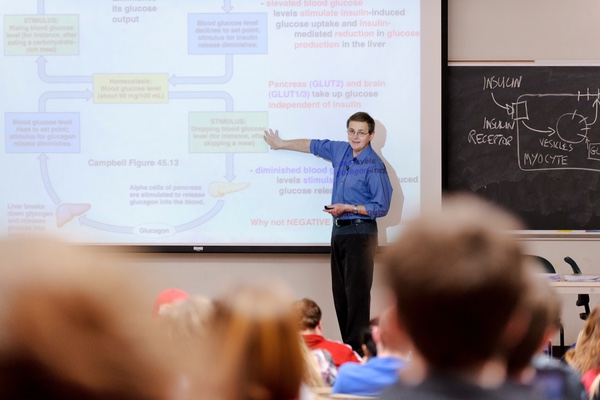
David Abbott retires after decades of field-changing PMOS/PCOS research
David Abbott, PhD, retired from the University of Wisconsin School of Medicine and Public Health Department of Obstetrics and Gynecology after a decades-long career as a leader in Polyendocrine Metabolic Ovary Syndrome (PMOS, formerly known as Polycystic Ovary Syndrome or PCOS) research. Dr. Abbott joined the faculty in the UW Department of Ob-Gyn and the Wisconsin National Primate Research Center in 1990; his central scientific achievement is the development of prenatally androgenized female rhesus monkey models of PMOS: the primate model that changed the field.
His work extended into adrenal hyperandrogenism, metabolic programming, epigenetic mechanisms, transgenerational/intergenerational transmission of PMOS, and most recently, he contributed to an evolutionary model of PMOS as an ancestral primate metabolic adaptation selected during late Pleistocene food scarcity. Overall, he has published over 200 studies that have garnered over 20,000 citations to date, while being supported as a PI or co-I on a dozen large National Institutes of Health grants with continuous funding for over 30 years. In 2021, he received the Ricardo Azziz Distinguished Researcher Award from the Androgen Excess and PCOS Society, which recognizes distinguished leadership in the field.
Dr. Abbott has also been a generous mentor, helping faculty and trainees in the Department of Ob-Gyn, the UW Endocrinology and Reproductive Physiology program, and others achieve their career goals. In the last 10 years alone, Dr. Abbott has received multiple campus-wide and departmental teaching awards, including: the UW–Madison Faculty Award for Mentoring Undergraduates in Research, Scholarly and Creative Activities in 2021; the Chester B. Martin, MD Graduate Training Program Mentorship Award in 2020; and the Luis "Ben" Curet Award in Ob-Gyn Educational Excellence in 2024.
Dr. Abbott shared reflections on a long and impactful career as a teacher, mentor and researcher who truly shaped a field. This conversation has been edited for length and clarity.
What were some of the most impactful discoveries in your field?
The discovery of a non-human primate model for fetal programming of PCOS was a paradigm shift in our clinical understanding of the disease. To realize it’s a developmental issue with its origins in pregnancy and pre-pregnancy, not an adult disease that we have to wait to do something about, was a big impact. We now also know PCOS is heritable, and that the likelihood of PCOS within families is very high.
Our primate models also established multiple PCOS phenotypes. Early on, the NIH criteria were high testosterone and intermittent cycles. Our primate models had more than that – their fat functions differently, they’re insulin-resistant, they have pancreatic defects, there’s more to it than just testosterone. In 2003 when the Rotterdam Criteria consensus meeting established four phenotypes for PCOS, they now matched what we saw in our primate model that had been published 10 years earlier. We had been a bit of a heretic group; we were just ahead of our time.
What’s next in PCOS and reproductive sciences research?
The next developments are going to be looking at animals with naturally occurring PCOS and understanding their genotypes and gene variants to really get at the molecular mechanisms of PCOS. That will get us to understanding how you can get testosterone-producing ovaries. And from there you can maybe develop antibodies to a key molecule in that pathway. Not to testosterone, not to luteinizing hormone, not to some basic things that would interfere with a lot of other reproductive biology, but something more select in the pathway that is more specific to the ovary.
The other issues are with the placenta, and that’s where Aleks [Stanic-Kostic, MD, PhD] and Jenna [Schmidt, PhD] are focusing on the immune function of the placenta to really understand exactly how it dysfunctions. And that's where this department’s future is looking as well, not just for PCOS, but for preeclampsia, hypertensive pregnancies and so on.
Why were teaching and mentoring an important focus of your career?
I see it as part of being at an R1, research-led university. Teaching is an important, integral part of research. Understanding material so I can help my students understand it improved my ability to research, formulate hypotheses, write grants and papers because I was making myself go through this process so I could help students learn to ask questions and process and apply what they’re learning.
Teaching involving residents, fellows, medical students, undergrads and graduate students can really enhance your well-being as well. Especially if you enjoy seeing the light going on with others, and not being afraid that they can go onto become far smarter at this than I am.
What do you hope is your career’s enduring impact?
I hope that I contributed to the progression and understanding of PCOS and that what we found remains a helpful underpinning of how people appreciate the clinical conditions. To see it, rather than a disease to be cured, as something that needs to be protected from today's environment.
And on the other side, I hope the students and those I had the pleasure of teaching or mentoring keep their minds always open, listening, questioning, rethinking how they move forward. Not being afraid to challenge and stand up for what the evidence shows, and be willing to reappraise if the evidence starts to mount differently.
You have to be flexible, you have to always question and always evaluate, and have the confidence to do that. So I hope that's the legacy that's there.
Published July 2026